Tavern · Personal project
A light but deep RPG card game system unlike any other.
A cooperative dungeon crawler card game and the larger expandable system that forms its foundation.
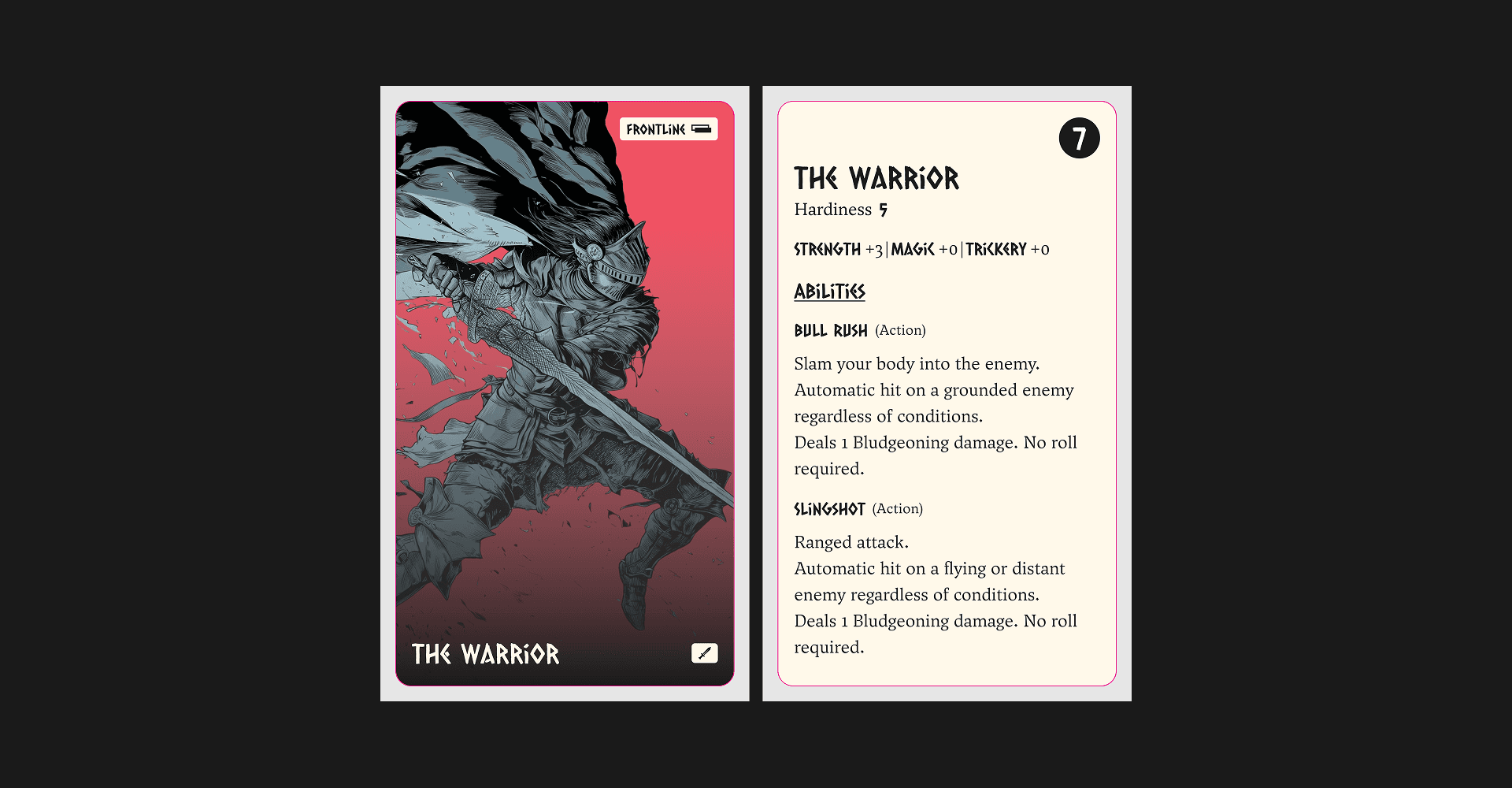
This is an early design for a game still in development. All visual assets and illustrations are placeholders and I do not claim ownership over the artwork.
A systems thinking and iterative design challenge: encoding a full RPG's worth of interlocking mechanics — combat, character identity, world reactivity — entirely onto a deck of cards.
The Hook
A systems design challenge: game elements focused on customization, replayability, and both facilitating and awarding creativity.
The Situation
Codename “Tavern” (name is in the works) is a cooperative dungeon-crawl card game for 2–6 players, designed to run in under an hour with no game master prep and no scheduling overhead beyond finding a free evening. It’s currently heading into its second round of playtesting. The intended audience is game enthusiasts hungry for the crunchiness of a classic RPG but with the flexibility to be played anytime, anywhere, and with nothing but a deck of cards.
Problem Statement
Players who already love RPGs need a way to get a real session in without the usual overhead: a dedicated game master who handles world-building, a group that can commit to a recurring schedule, and hours of prep.
The game has to deliver a full RPG’s worth of interlocking systems — combat, character identity, meaningful choice, a world that reacts — encoded entirely onto a deck of cards.
User Needs
- Get a real session in under an hour with people I already know, no dedicated GM required
- Build a character with real identity, not a stat block wearing a different name
- Read every mechanic off the card in front of me, with nothing left to house rules
- See a room actually respond to what my party does, not just resolve the same way regardless
- Have a reason to come back to the same box more than once
The Tension
The role of a classic GM/DM is turned into the role of “Bard.” A player who adjudicates, facilitates, and acts on behalf of the world the game takes place in — but without the hours of prep and need to improvise a world on the spot. The system must support the Bard, ensuring they have the answers, while allowing the players to be creative and for each playthrough to feel distinct, unique, and memorable.
The Design
The Approach
- Establishing the system
- Writing the content
- Compiling a demo deck
- Play-test live with real players, collect feedback
- Iterate
- Repeat
The Outcome
- A scalable system — A game structure with elements that can be customized to a specific setting, ensuring a system that can scale and be iterated on infinitely.
- Customizable characters — Deceptively simple and approachable characters with layers of depth and customization for those who want it.
- The dungeon — The setting the game sessions take place in. Different every time you play it, and geared towards creative use of skills and abilities to solve open-ended problems.
- Combat — Scalable to party size and composition, easily run by a Bard played by either a seasoned gamer or a gaming newbie.
Working with Claude as a Creative Partner
- Understanding when and where to use Claude and Gemini as true thought-partners to supplement my own creativity.
- Learning that AI is great for helping generate ideas, but at the end of the day, you can't replace human creativity.
- Harnessing Claude as an assistant to help cover iterations, decision logs, and content documentation.
Data Simulation with Claude
Rather than relying on playtest rounds alone to catch balance problems, I wanted to reduce that dependency as much as possible by getting the underlying numbers right before people sat down to play. Working with Claude, I built a Monte Carlo combat simulator that runs thousands of simulated encounters against the game’s actual rules, testing party size, composition, and enemy difficulty against each other well beyond what manual math or a handful of playtest sessions could realistically cover.
The simulator was only useful if it reflected the real design, not a simplified stand-in for it. That meant feeding it the game’s actual mechanical identity, like a character whose whole playstyle depends on chaining two different abilities together, rather than reducing every character to a generic damage number.
Sample simulation output
| Party Size | Resources Lost / Player | Chance of Party Wipe |
|---|---|---|
| 1 player | 4.05 | 40.2% |
| 2 players | 3.25 | 9.4% |
| 3 players | 1.69 | 0.1% |
| 4+ players | ~1.0 or less | 0.0% |
Scenario: one lighter encounter and one standard encounter back to back, no rest in between.
Finding: solo and duo parties chaining two encounters without a rest carry disproportionate risk, well beyond what the same math predicts at 3+ players, directly shaping how a solo-play balance mechanic needed to be tuned.
Every simulation answers a fixed, repeatable set of questions and reports results the same way each time, so runs stay comparable to each other rather than each becoming a one-off calculation. Just as intentionally, results are written in plain language rather than raw statistics, so the takeaways are usable by anyone on a future team, not just legible to me as the current solo designer.